
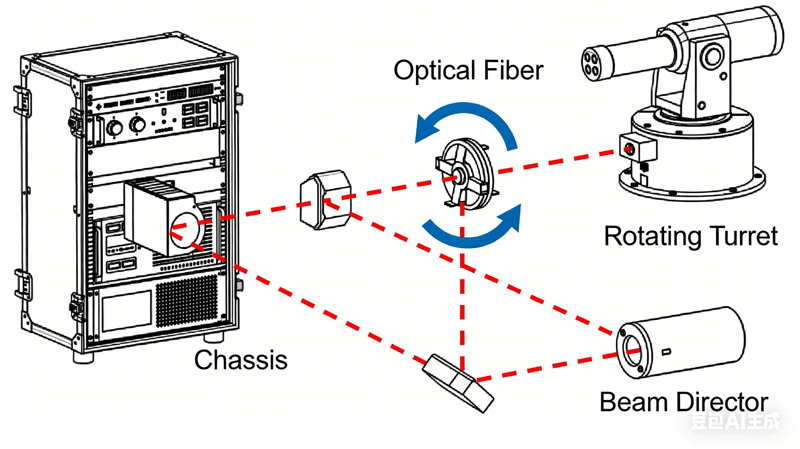
The rapid evolution of laser technology has shifted the industry’s focus toward the precision of energy delivery. For engineers working with LIDAR, robotic arms or medical scanners, the challenge has always been maintaining a stable laser beam across a rotating interface.
Traditional mechanical slip rings struggle with the high data rates and power densities required by modern industrial lasers. This is where the Fiber Optic Rotary Joint (FORJ) or fiber optic slip ring, becomes the unsung hero of synchronized rotation and transmission.
Grand Technology has recently designed a structural specifically optimized for high-energy laser transfer. By focusing on thermal management and optical alignment, this new architecture bridges the gap between theoretical efficiency and industrial reliability.
The Fiber Selection in Laser Power Transmission
Selecting the right medium is the foundation of any high-performance optical system. In laser energy transmission, we are not just moving data, we are moving raw thermal energy.
Optical Properties and Attenuation
The transmission loss must be minimized to prevent heat buildup within the slip ring housing. Grand’s research emphasizes analyzing fiber characteristics such as numerical aperture (NA) and core diameter to match the laser source.
Durability and Thermal Resistance
High-power lasers generate significant heat at the interface. Fibers must feature specialized cladding and coatings to withstand localized temperature spikes without degrading the signal or the physical glass structure.
Quick Insight
While standard silica fibers work for communication, high-energy applications often require Large Mode Area (LMA) fibers to reduce power density and prevent non-linear effects.
Structural Design: Enhancing Thermal Conductivity and Mechanical Strength
The physical housing of a fiber optic slip ring is just as vital as the glass inside. Without proper structural integrity, centrifugal forces can cause misalignment.
Material Innovation for Heat Dissipation
Design utilizes materials with high thermal conductivity to pull heat away from the optical coupling point. This prevents the “thermal lens” effect, which can distort the laser beam profile.
Geometric Optimization for Stability
The shape of the slip ring must balance compactness with the need for robust internal bearings. A stable mechanical “seat” ensures that the two fiber ends remain aligned within microns, even at high RPMs.
Expert Note
In 2024-2025, industry trends show a 15% increase in the adoption of hybrid slip rings (combining electrical and optical channels) in the wind energy and defense sectors.
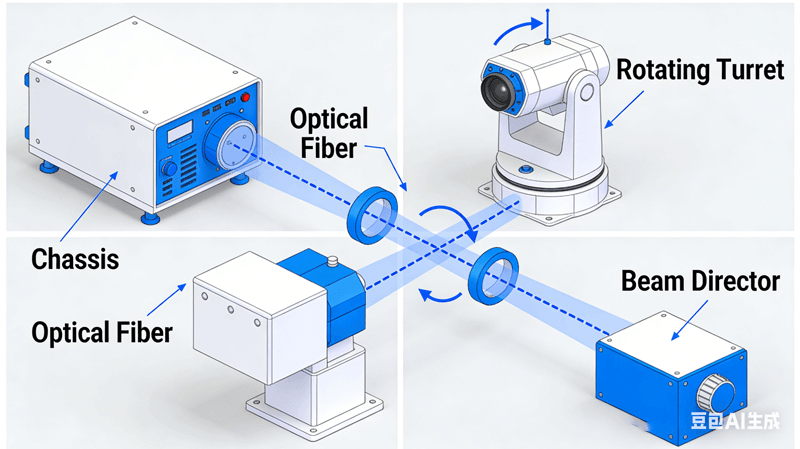
Precision Manufacturing and Installation Techniques
A brilliant design fails if the execution is flawed. The manufacturing process for laser slip rings requires clean-room environments and sub-micron machining.
Processing and Assembly Details
Every surface must be treated to prevent reflections that could bounce back into the laser source. We highlights the importance of the assembly sequence to ensure that the fiber remains tension-free during rotation.
Strategic Placement
The location of the slip ring within the larger machine affects its lifespan. Ensuring easy access for maintenance while shielding it from external vibrations is a key consideration in the Chihong study.
Summary
Precision in the manufacturing phase directly correlates to a lower “Insertion Loss” (IL) and higher “Return Loss” (RL).
Performance Testing: Validating Efficiency and Reliability
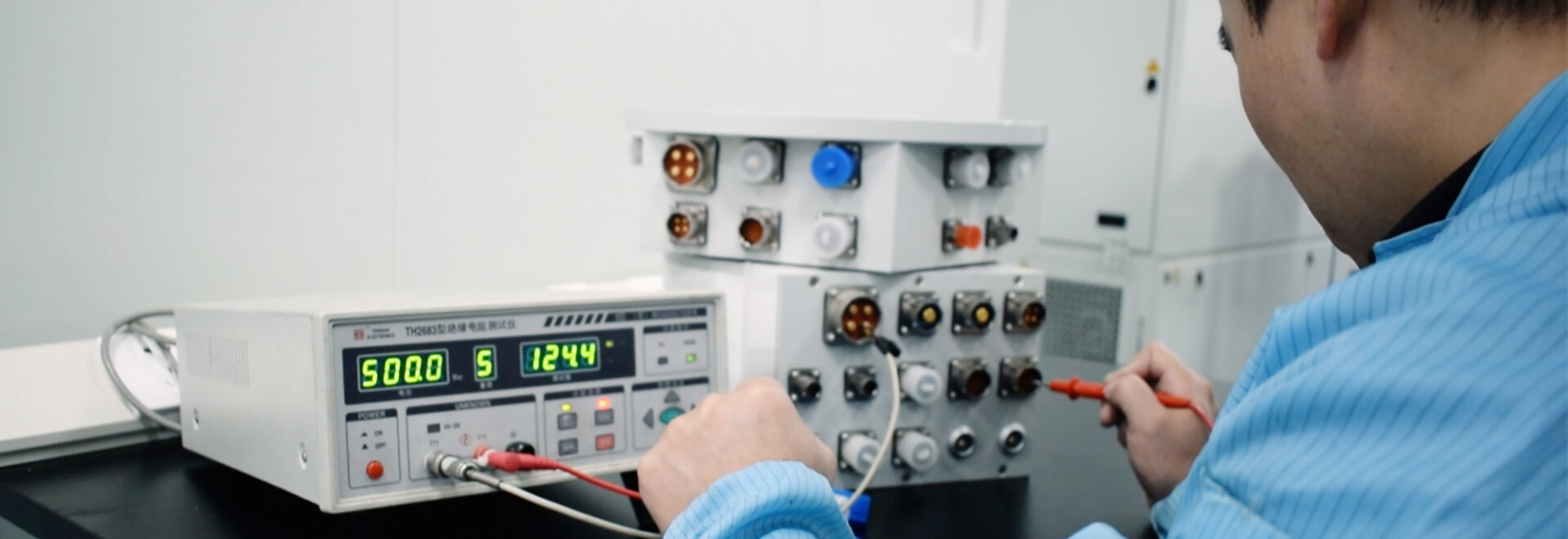
To prove the feasibility of the design, rigorous testing protocols were established. You cannot manage what you do not measure.
Key Performance Indicators (KPIs)
- Transmission Efficiency: The percentage of input power that successfully exits the slip ring.
- Rotational Variation: Monitoring if the power flickers or drops as the joint spins.
- Thermal Stability: Measuring the temperature delta during long-duration runs.
Experimental Data Analysis
Through a series of comparative tests, we verified that their structural improvements led to a significant reduction in transmission loss compared to standard models. This data confirms the design’s readiness for industrial application.
| Parameter | Standard Design | Optimized Design |
| Insertion Loss (dB) | < 2.0 | < 1.2 |
| Power Handling (W) | 50 – 100 | 200+ |
| Rotational Life | 10M Revolutions | 50M+ Revolutions |
Future Frontiers in Laser Energy Control
While the current design is effective, the horizon of laser technology is constantly expanding. We hope the next iteration of optical slip ring is coming soon.
Increasing Power Thresholds
Future research will focus on “hollow-core” fibers to transmit even higher energies with near-zero material interaction. This could revolutionize high-power laser welding and cutting.
Material Science Breakthroughs
Developing even more durable fiber coatings will allow these slip rings to operate in extreme environments, such as deep-sea exploration or aerospace.
FAQ: Frequently Asked Questions about Fiber Optic Slip Rings
- What is the main cause of energy loss in a fiber slip ring?
- The primary causes are axial misalignment, angular error, and reflections at the air-gap interface. Precision manufacturing and anti-reflective coatings are used to mitigate these.
- Can fiber optic rotary joints handle high-wattage lasers?
- Yes, but they require specialized structural designs, focusing on high thermal conductivity materials and heat dissipation.
- How do I choose between a single-channel and multi-channel FORJ?
- This depends on your application. Single-channel joints are typically more robust for high-power energy transfer, while multi-channel units are better for complex data sensor arrays.
Summary and Next Steps
The Grand Technology design proves that with the right mix of material science and mechanical engineering, laser energy can be transmitted with high efficiency across rotating planes. This opens doors for more reliable medical lasers, more precise industrial robots, and advanced communication systems.
Are you looking to integrate high-power laser transmission into your rotating hardware?
[Contact our technical team today to discuss a custom FORJ solution for your project.]
See What We Can Do